Ramp's unhinged Rollercoaster Tycoon 2 design fiction experiment
Literally a wild ride.

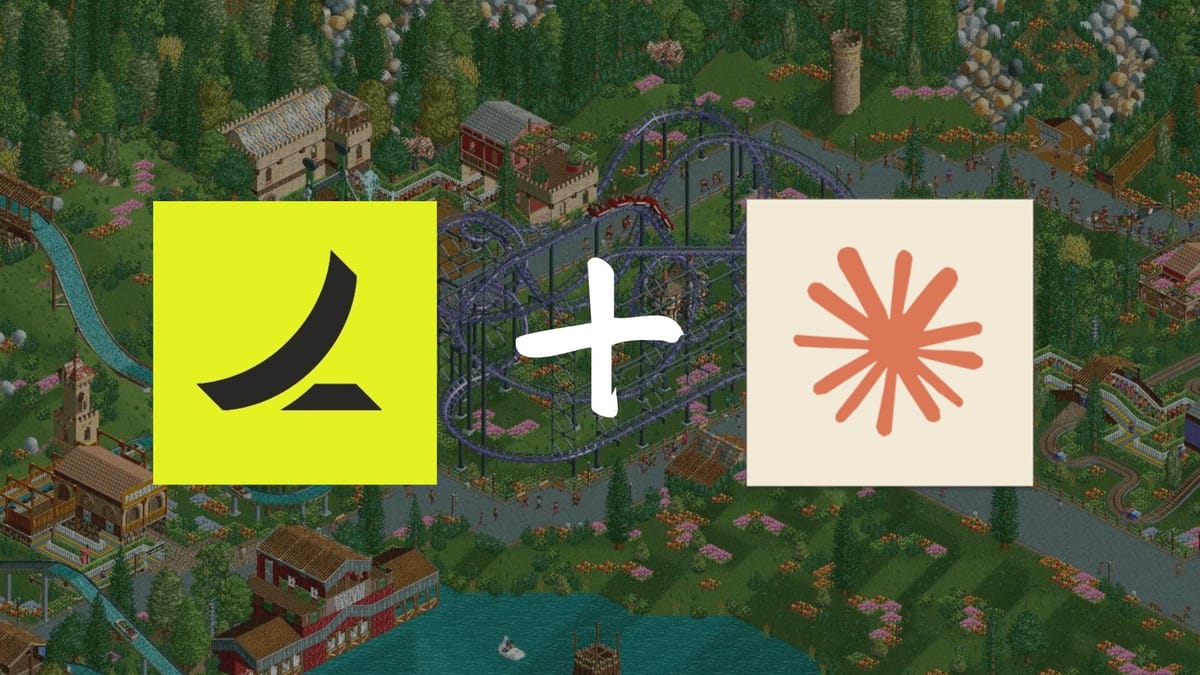
Ramp (the fintech company) ran a seemingly unhinged experiment in which they let Claude Code take the reins of a theme park in RollerCoaster Tycoon2.
To build this project, the Ramp team used OpenRCT2, an open source reimplementation of RollerCoaster Tycoon 2, and vibe coded an extensive command line interface called rctcli to allow Claude to access every available action in the game. They don't say how many lines of code they had to produce, but they did say it "follows the patterns and conventions of kubectl, the expansive CLI behind Kubernetes, one of the most complicated pieces of software ever created."
That sounds like a lot of lines of code.
The setup gives Claude unfettered access to make decisions in the game—from where to put to put new rides and amenities, to hiring staff, to changing prices to keep the park profitable.
The AI generated the tooling, and then it ran the show. I'm impressed by the scale of what the Ramp team produced—which is a huge undertaking—especially as a vibe coded project. But I'm most interested in how this project is a remarkable example of design fiction.
The team at Near Future Laboratory (who literally wrote the book on design fiction) define it this way:
Design fiction is the practice of creating tangible and evocative prototypes from possible near futures to help discover and represent the consequences of decision making...
...Design fiction takes an ordinary thing like a box of cereal, and uses it as a canvas to visualize insights, research and trends as if they had actually happened. Bringing them together like this lets us experience these changes in ways that a chart never could and forces us to embrace the details in ways that a concept video never would. A design fiction prototype allows for the abstract to become real for a moment, it helps focus the conversation in a grounded way. It breaks down abstractions, and asks a group of people to think in detail about where the future might be headed, and how we’ll all experience it. Design fiction aims to capture the full context of our future so that we can feel like we’re really living in it.
Creating a direct connection between Claude Code and RollerCoaster Tycoon 2 removes the abstractions around letting AI work autonomously in a business context where real dollars and human resources are on the line.
As a work of design fiction, the project provides a context to ask critical and timely questions about the degree to which it's possible—and desirable—for AI to be embedded into business operations. In the game, Claude called the shots, but we have to ask:
- Are we OK with AI tuning and tweaking prices automatically? (I'm aware that this already happens, especially with airfares)
- Are we comfortable with AI influencing staffing decisions, even when it seems in best interest of the company?
- When a LLM is given unfettered access to a system, how do we ensure that the human-in-the-loop stays in the loop?
- What are the real-world security implications of autonomous agents?
- What are the real limits of LLM decision making?
- What processes remain a distinctly human endeavor?
- In what way do autonomous systems elevate, deepen, endanger, or compromise our work?
Automating diligence
Seeing an AI play a game and make decisions in real time makes it a whole lot easier to weigh these kinds of questions. As a fintech company, Ramp has a keen interest in figuring out how to integrate AI thoughtfully into its product offerings, and I appreciate many of the conclusions that their team arrived at through this project. In reflecting on the project, this is what Jay Sobel, Software Engineer at Ramp says:
As a mirror to real-world agent design: the limiting factor for general-purpose agents is the legibility of their environments, and the strength of their interfaces. For this reason, we prefer to think of agents as automating diligence, rather than intelligence, for operational challenges.
Claude displayed a lot of strengths throughout the game, but the spatial nature of RollerCoaster Tycoon 2 highlighted it's greatest weakness: spatial reasoning. Claude has an enormous context window, but even with the hacks the Ramp team included to help Claude understand 3D space, it made poor decisions about expanding the park and positioning new rides.
I like the concept of "automating diligence" instead of "automating intelligence." AI is great at pattern matching, at identifying trends and anomalies that are hard to see at scale. That's the diligence part—going deeper into the data than we could on our own.
But the real thinking and strategy—the intelligence part—remains squarely in the human domain.
Design fiction enables us to define where the lines are. Clear lines between what's best handled by a human and what's best handled by a computer helps us make the most of the tools we have so we can do our best work yet.
For more on the AI experiments Ramp is running, check out https://labs.ramp.com