I don't believe in marketing funnels anymore
Byron Sharp provides a simpler model.


It's a controversial view, but here we are.
Byron Sharp of the Ehrenberg-Bass Institute has challenged my thinking on this over three podcast episodes (linked below) with this argument:
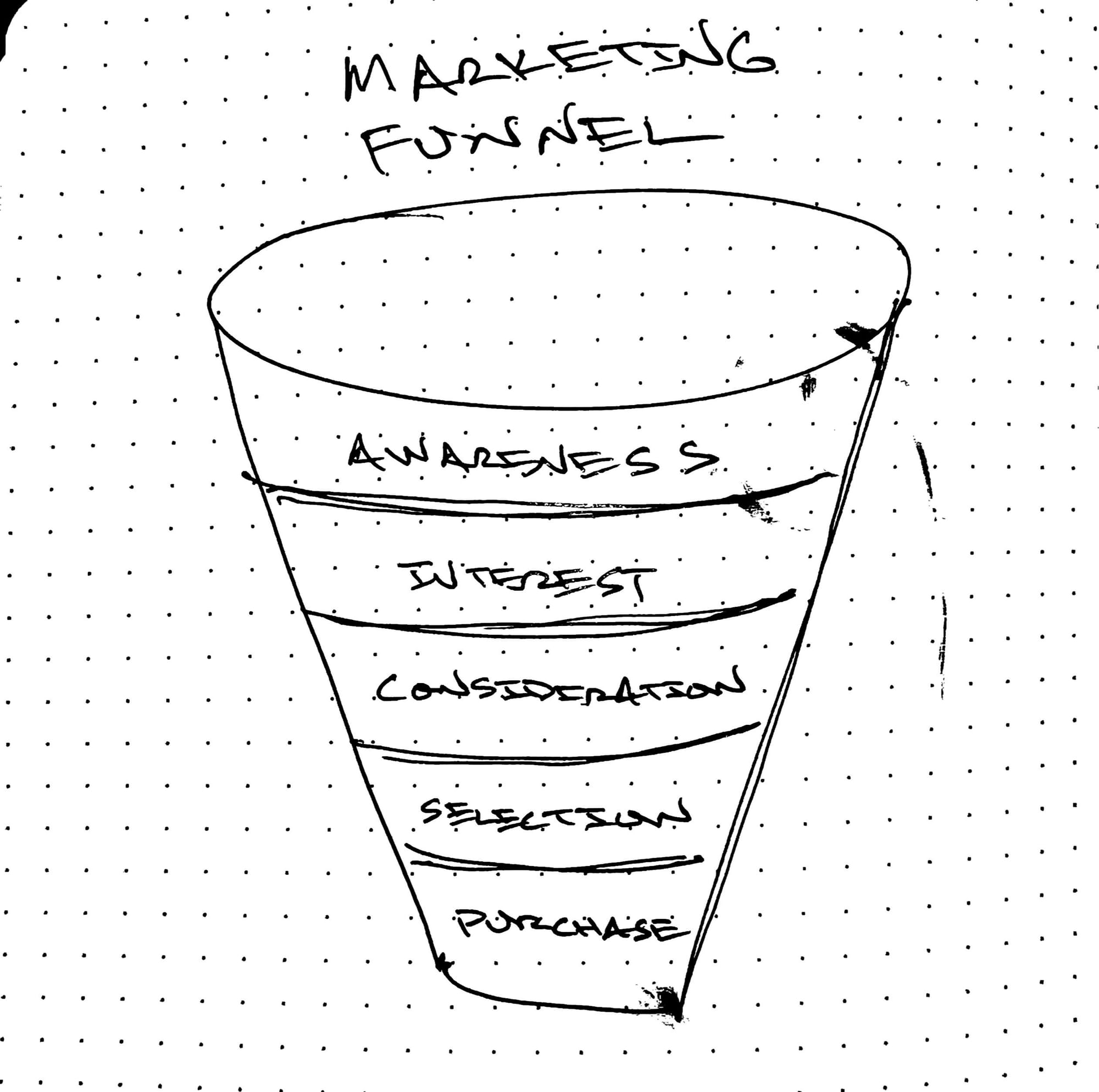
There's no funnel in the sense of awareness, interest, consideration, selection, and purchase. The only two marketing levers that matter are:
- Mental availability: Do customers know who you are?
- Purchase availability: How easy is it for people to buy from you?
Let's take a closer look at each lever.
Mental availability
Building mental availability means that customers know and remember that you exist so they think of you the next time the need to buy something in your category of product or service.
When I was at the Ahrefs Evolve conference in 2025, Peep Laja from Wynter showed a video in which he went around at a tech conference and asked a bunch of people to list off as many companies as possible that offer a B2B marketing research tool (I think this was the prompt if memory serves me right).
The point is the people could only list one or two products in the entire category. I don't recall anyone listing more than 4.
Peep explained that buyers create a mental shortlist of the available options in a given product or service category. People aren't trudging through dozens of options to find the veritable needle-in-the-haystack "best option." They simply go through their short list and make a choice based on what seems best.
This insight collapses the awareness / interest / consideration / selection stages of the funnel.
Mental availability allows your product/service to be on the shortlist of your potential customers and can be built all kinds of ways: ads, blogs, social, video, etc. What might be described as a high-intent, bottom-of-funnel ad (i.e., an ad that implores customers to buy now), is really just a mechanism to build mental availability. Likewise, a YouTube video designed to "build top-of-funnel awareness" is simply building mental availability about a product or service.
Creating the awareness and recall about your product or service is what helps drive the purchase.
Purchase availability
You can end up on the mental shortlist and still miss the sale if it's difficult for people to buy from you. Simple logic.
Purchase availability means that it's easy for people to buy from you when they think about your brand. That means:
- You're open when your customers need you
- Your product is accessible in the stores where they shop
- Someone promptly answers the phone or email inquiry to process the inquiry or order
- Popular and expected payment methods are supported
- Website checkout UX is easy to navigate
- Unnecessary friction for finding and purchasing your product is removed
The purchase stage of the funnel survives because it is the key outcome of marketing.
Where I think funnels might still be useful
A marketing funnel is just a mental model. So is the concept of mental availability/purchase availability. Different mental models are helpful in different contexts.
I still think funnels can sometimes be a useful mental model for discussing strategies and tactics. For example:
- "We're making this ad to introduce people to our brand—this is more of a top-of-funnel piece of content."
- "This ad is for people who need this service right now—this is bottom of funnel for people ready to take action."
The marketing funnel mental model can help articulate to describe the intent behind an asset or creative, but everyone on the team needs to be clear-eyed about the fact that all creative is doing the same job of building mental availability.
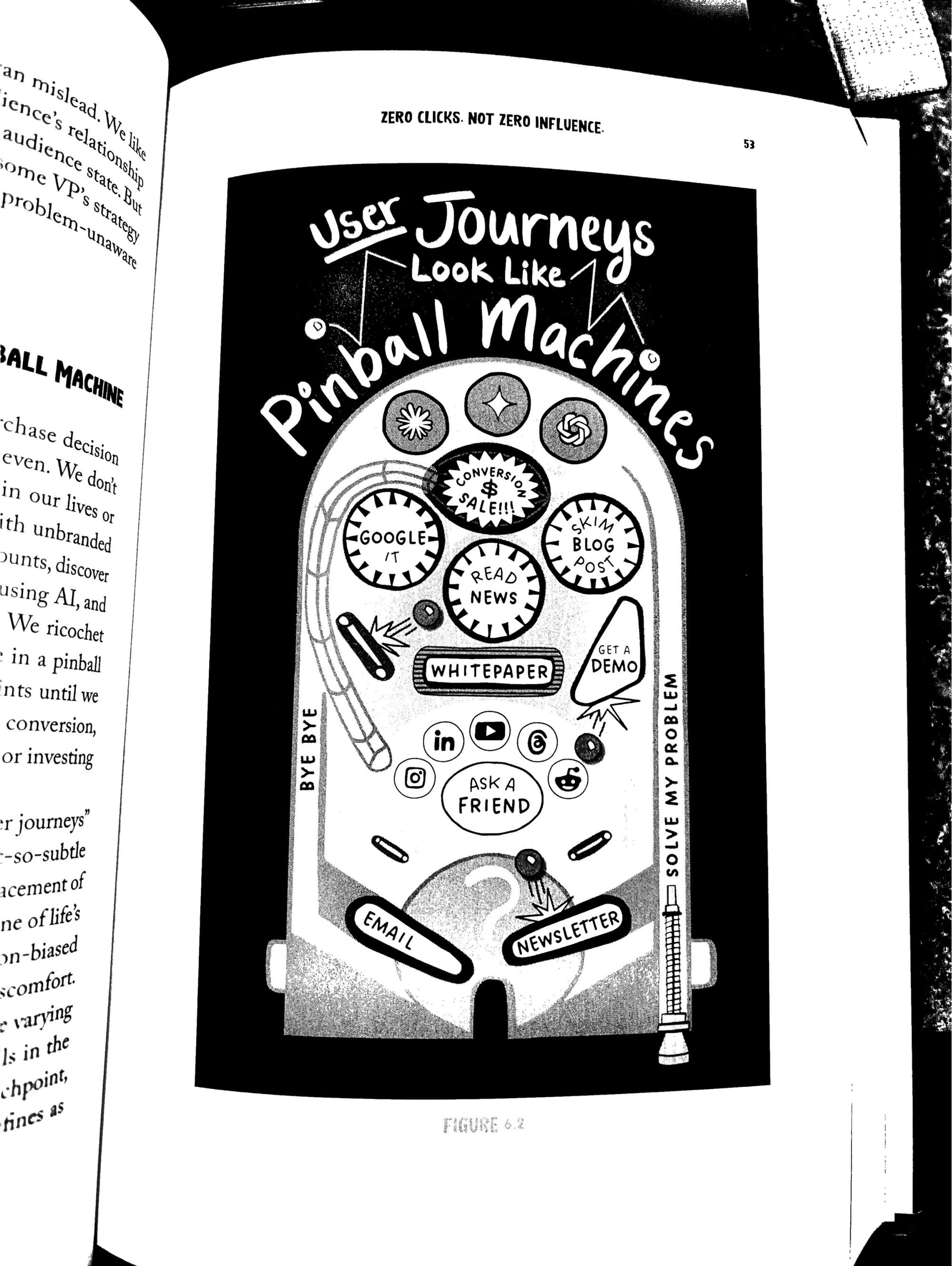
With that said, I think the funnel model has the potential to cause more issues because it contains implicit assumptions about how marketing works (i.e. that customers move across a linear path, which is simply not true). It's far too easy for teams and leaderships to be seduced into thinking that customers can be influenced across a clear cut journey, when in fact, it's a super messy path. Amanda Natividad and Rand Fishkin of SparkToro call it the Pinball Customer Journey Pinball Machine.
The value of ditching marketing funnels
First off: simplification. When we get rid of the funnel, we can have a real conversation about what marketing does, which is getting more people to know and trust your brand. We're not influencing customers across a meticulously crafted path, we're trying to get incredibly busy, distracted humans to remember who we are when it matters.
Instead of talking in abstractions about what we think our marketing is doing at such-and-such nebulous stage in the buyer's journey, we can discuss how and when we want to be remembered and what for. That's a powerful shift that can help brands move away from what Emily Kramer calls "random acts of marketing," which is basically marketing spinning its wheels without a unifying strategy. Mental availability allows us to ask the right questions so we align marketing to real goals.
Second: clarification of marketing's scope. The last stage in the marketing funnel is "purchase" or "conversion," which identifies buying as the key outcome. But the funnel obscures everything that goes into making that purchase happen: product distribution, UX, etc. The concept of purchase availability makes it possible to have a real conversation with leadership about janky checkout flows, sub-optimal product placement and the like.
Marketing can be doing incredible work in building mental availability, but if purchase availability isn't in within marketing's purview, all of that hard work in building mental availability will go to waste, and as a result, marketing spend will look wildly inefficient. And the reason will be that marketing had no say or influence in the most important step in the buyer's journey.
Simple models make it easier for everyone to understand what's going on, what the goals are, and why it matters. As it becomes increasingly difficult to analuzed customer journeys because of privacy laws, tracking blockers, fragmented content consumption across multiple channels, and more, we need simple, time-tested models that succinctly capture what marketing is and what it should be doing. Mental availability / purchase availability is that model.
Podcasts with Byron Sharp
If you want to evaluate Sharp's argument's on your own, check out the following podcasts:
What Marketing Science Says About Growing a Brand | Professor Byron Sharp (Ehrenberg-Bass Institute) | Ahrefs Podcast: If you listen to one episode, this is the one. This was the first time I heard Sharp's ideas, and it prompted me to listen to more.
Byron Sharp vs Mark Ritson - 5 big marketing truths we agree on | Uncensored CMO: Casual convo between Byron Sharp and Mark Ritson at Cannes Lions in 2026. Sometimes a bit hard to follow because it's looser than a podcast interview, but still plenty of good insights from two highly opinionated marketers.
Byron Sharp: "There is only one science." | A History of Marketing: Good overview of how Sharp's ideas signaled a new era in thinking and scholarship about marketing. I found this episode to be an interesting history on both marketing and how the Ehrenberg-Bass Institute came to be.